Exterior House Painting Cost in West London: 2026 Price Guide
Exterior painting is the cheapest thing you can do to a house that changes how it looks from the street, and the easiest thing to get wrong. Most of the price is not paint. It is preparation, access and weather, and those three are also what decides whether the finish lasts three years or ten.
This guide from GSM Builders Ltd, builders based in Hayes, gives realistic 2026 prices for repainting the outside of a house in Hillingdon, Ealing, Hounslow, Harrow and Uxbridge, explains where the money goes, and is honest about the time of year, which matters more than most people expect.
Exterior painting cost: the short answer
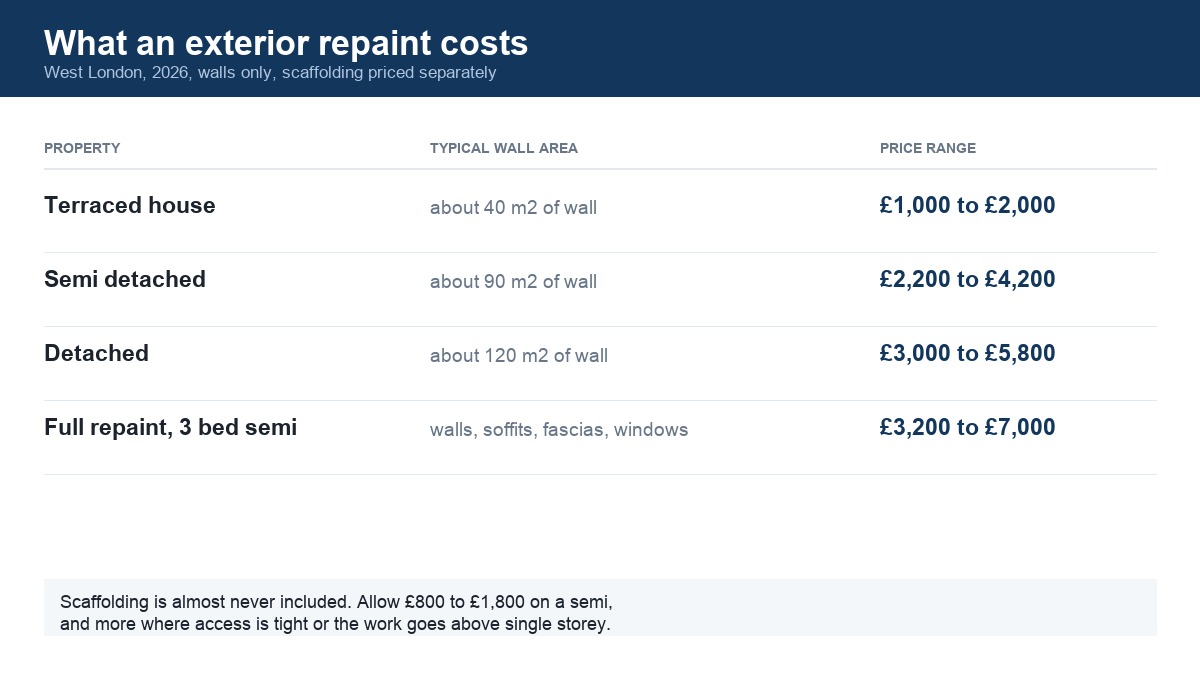
In West London, repainting the walls of a terraced house costs roughly £1,000 to £2,000. A semi detached is £2,200 to £4,200, and a detached house £3,000 to £5,800. A full repaint of a three bedroom semi, taking in walls, soffits, fascias and window frames, usually lands between £3,200 and £7,000.
Those are labour and materials for the painting itself. Scaffolding is almost always priced separately, and on a semi it adds £800 to £1,800. That single line is the most common reason two quotes look thousands apart when they are actually describing the same job.
| Property | Rough wall area | Walls only | Plus scaffolding |
|---|---|---|---|
| Terraced house | about 40 m2 | £1,000 to £2,000 | £400 to £1,200 |
| Semi detached | about 90 m2 | £2,200 to £4,200 | £800 to £1,800 |
| Detached | about 120 m2 | £3,000 to £5,800 | £1,000 to £2,400 |
| Full repaint, 3 bed semi | walls, soffits, fascias, frames | £3,200 to £7,000 | £800 to £1,800 |
Priced by area rather than by house, a straightforward clean and recoat runs about £12 to £20 per square metre. Add minor filling and repairs and it is £20 to £35. Where the render is blown, the brick needs stabilising or old flaking coatings have to come off, it climbs to £35 to £60 per square metre, and at that point the paint is the small part of the bill.
Why the quote is mostly labour
A London painter and decorator charges somewhere around £150 to £250 a day, with experienced trades at £220 to £280 and specialists higher again. Materials for an average semi might be £300 to £600. So when you compare quotes you are almost entirely comparing how many days each firm has allowed, and that is a question about preparation.
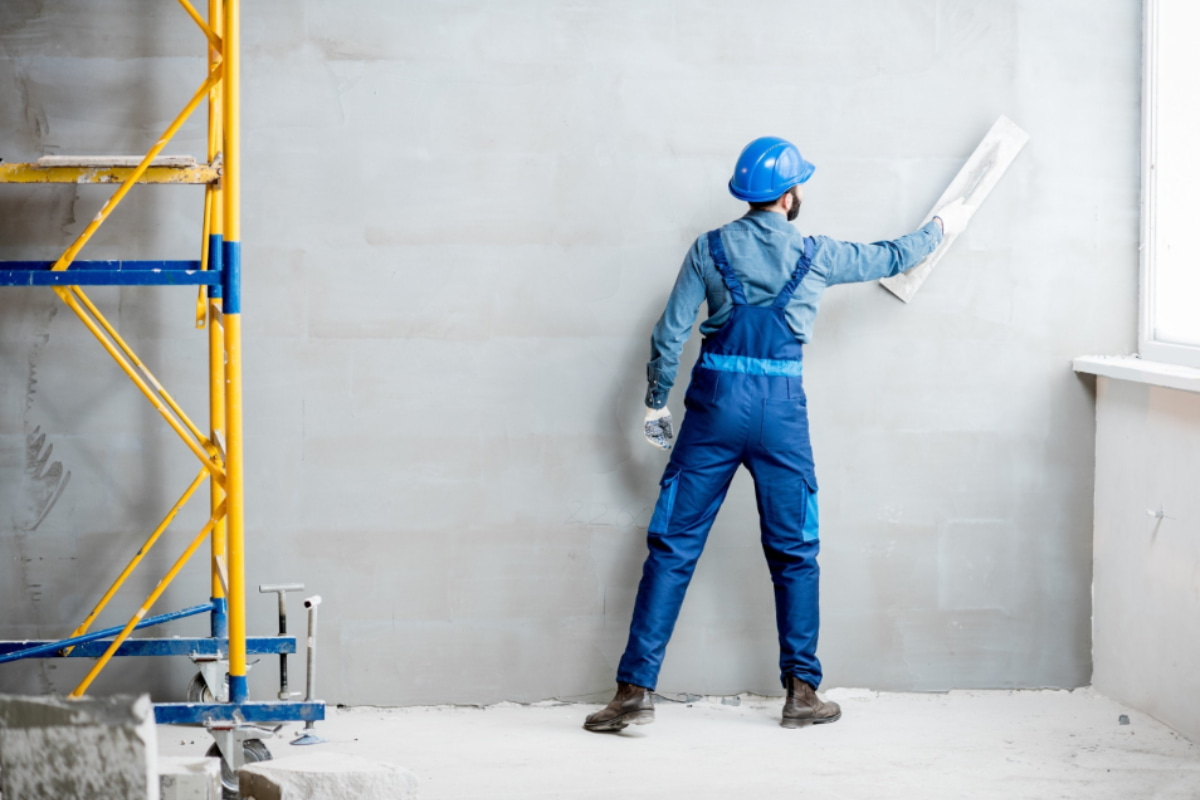
Preparation on a typical West London house means washing down and killing off algae, raking out and filling cracks, treating any blown or hollow render, sanding and priming bare timber on fascias and frames, and masking everything that is not being painted. Done properly it is often half the labour on the job.
- A quote with no mention of washing down or algae treatment has not allowed for it
- A quote that does not say how many coats is a quote you cannot compare
- Two coats on bare or previously unpainted masonry is a minimum, not an upsell
- Bare timber needs a primer, an undercoat and a topcoat, which is three passes and three drying windows
The time of year matters more than people think
Masonry paint needs the surface to be between roughly 5 and 25 degrees, and it needs the wall to stay dry for at least a day after it goes on. In London that gives you a reliable window of April to early July, and a shorter second one in September.
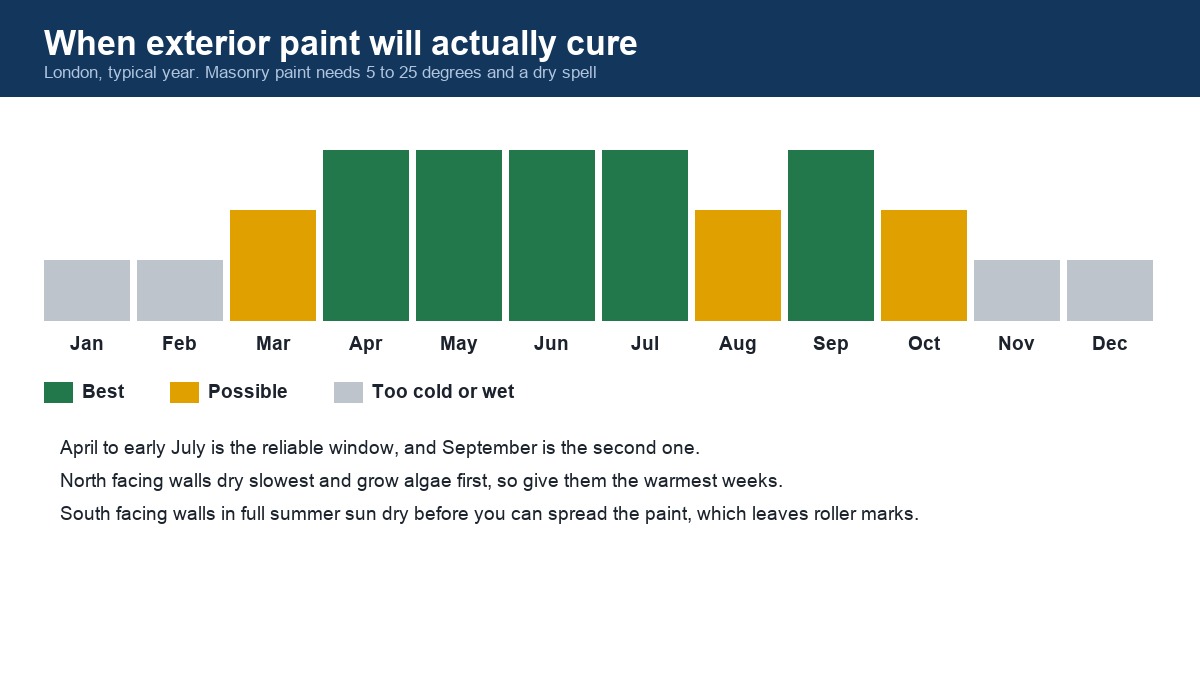
If you are reading this in autumn and getting quotes now, the honest answer is that you are booking for spring. A firm that offers to start your exterior in November is either planning to work only on sheltered elevations or is not telling you the whole story. The exceptions are small patch repairs and anything fully sheeted under scaffold.
Two details that catch people out even inside the good window. North facing walls dry slowest and are the first to grow algae back, so they want the warmest, driest weeks you can give them. South facing walls in full summer sun do the opposite and dry faster than you can spread the paint, which leaves roller marks and lap lines, so those get done in morning shade or on an overcast day.
What your walls are made of changes everything
Painted render and pebbledash
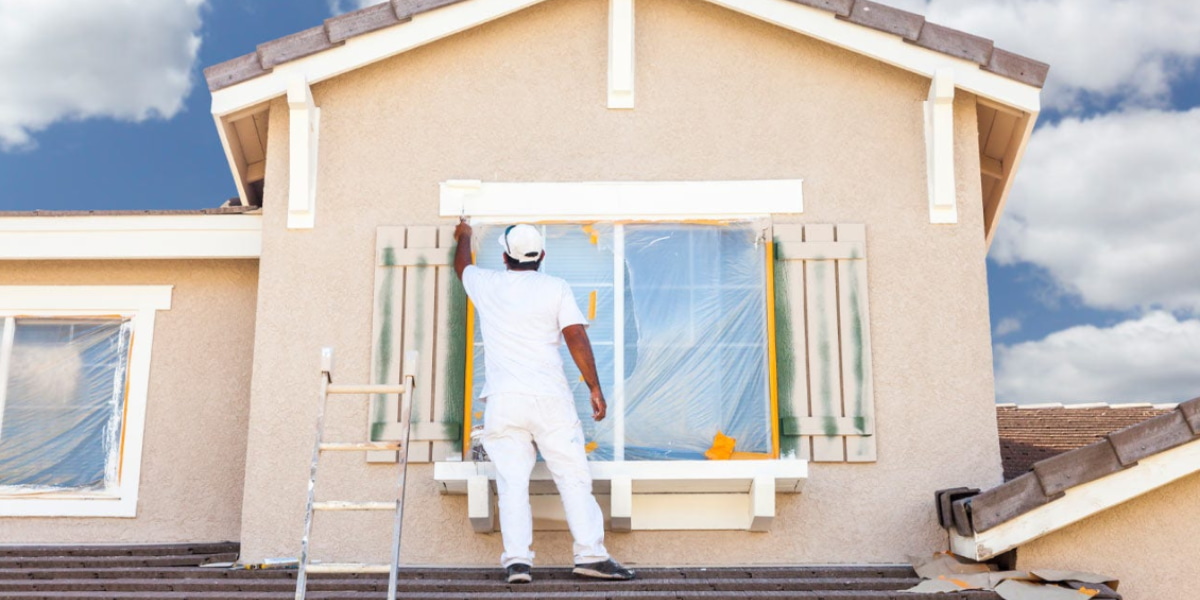
The most common thing we repaint around Hayes and Hounslow. Render moves and cracks, so it needs filling and a flexible masonry coating. Expect to repaint every 5 to 10 years. Pebbledash drinks paint, so add 20 to 30 percent on materials and allow for a thicker coat.
Fair faced brick
Our usual advice is do not paint it. Once brick is painted it has to stay painted, because stripping it later is slow and expensive and often damages the face. Brick that looks tired usually wants cleaning and repointing instead, which costs more now and far less over twenty years.
Timber fascias, soffits and frames
This is where most exterior paint actually fails, because it is the part that moves and takes the weather. Rotten sections need cutting out and splicing before anything is painted. A good decorator will tell you about this at quoting stage; a cheap one paints over it and it shows within two winters.
The five things that move the price
1. Access. Scaffolding versus towers versus ladders, and whether your house is on a street where the scaffold needs a licence. Anything above single storey, or anything over a conservatory or an awkward side return, is the single biggest variable.
2. Condition. A wall that was last painted well five years ago is a different job from one with flaking 1980s masonry paint over blown render.
3. Detail. Bay windows, barge boards, decorative mouldings and multiple small panes are all cutting in by hand. A plain elevation goes three times faster than a fussy one.
4. Colour change. Going lighter over a dark wall, or any strong colour, can mean an extra coat across the whole house.
5. What else is being done. If the scaffold is going up anyway, doing the roofline, the gutters or the windows at the same time is far cheaper than bringing it back next year.
How to compare three painting quotes
Ask all three for the same four things and the comparison becomes simple. How many days on site. How many coats, and on what. Is scaffolding included, and whose licence. What preparation is allowed for, in writing.
If one quote is dramatically lower, it is almost never the same job. Usually it is fewer coats, no scaffold, or preparation that amounts to a quick wash. That is worth knowing before you choose, not afterwards. Our guide on how to choose a builder in West London goes through the same checks for larger work.
Common questions
How long does it take to paint the outside of a house?
A terrace is usually 3 to 5 days, a semi 5 to 8, a detached house 8 to 12, including preparation and drying time between coats. Scaffolding adds a day at each end.
How often should I repaint?
Painted render every 5 to 10 years, timber every 3 to 5 depending on how exposed it is. South and west facing elevations always go first.
Can you paint in winter?
Not reliably. Some paints claim application down to 2 degrees, but in a London winter the wall rarely gets a dry enough spell to cure properly. Booking a spring slot in autumn is normal and usually gets you a better price than a last minute summer job.
Do I need permission to paint my house?
Usually no. But if your house is listed, or you are in a conservation area, changing the colour of the exterior can need consent. Parts of Ealing and Uxbridge have conservation areas where this applies, so it is worth one phone call to the council first.
Getting a price for your house
We are a family run building company based at 13 Leven Way in Hayes, and we work across Hillingdon, Ealing, Hounslow, Harrow and Uxbridge. If you want a straight answer on what your house needs, and whether it is worth waiting for spring, we will come and look and tell you honestly. You can see what we cover on our exterior painting page, or get in touch for a free quote.
If you are planning bigger work at the same time, our guides to house extension costs and full house renovation costs in West London may help you sequence it, because paint should always be the last thing you do.